We just finished Bodhi’s Blissful Adventure. This is the first book designed to focus on one of the 13 Forest Friends in The Everlasting Forest series.
Bodhi’s Blissful Adventure – The Everlasting Forest is now available through Amazon.
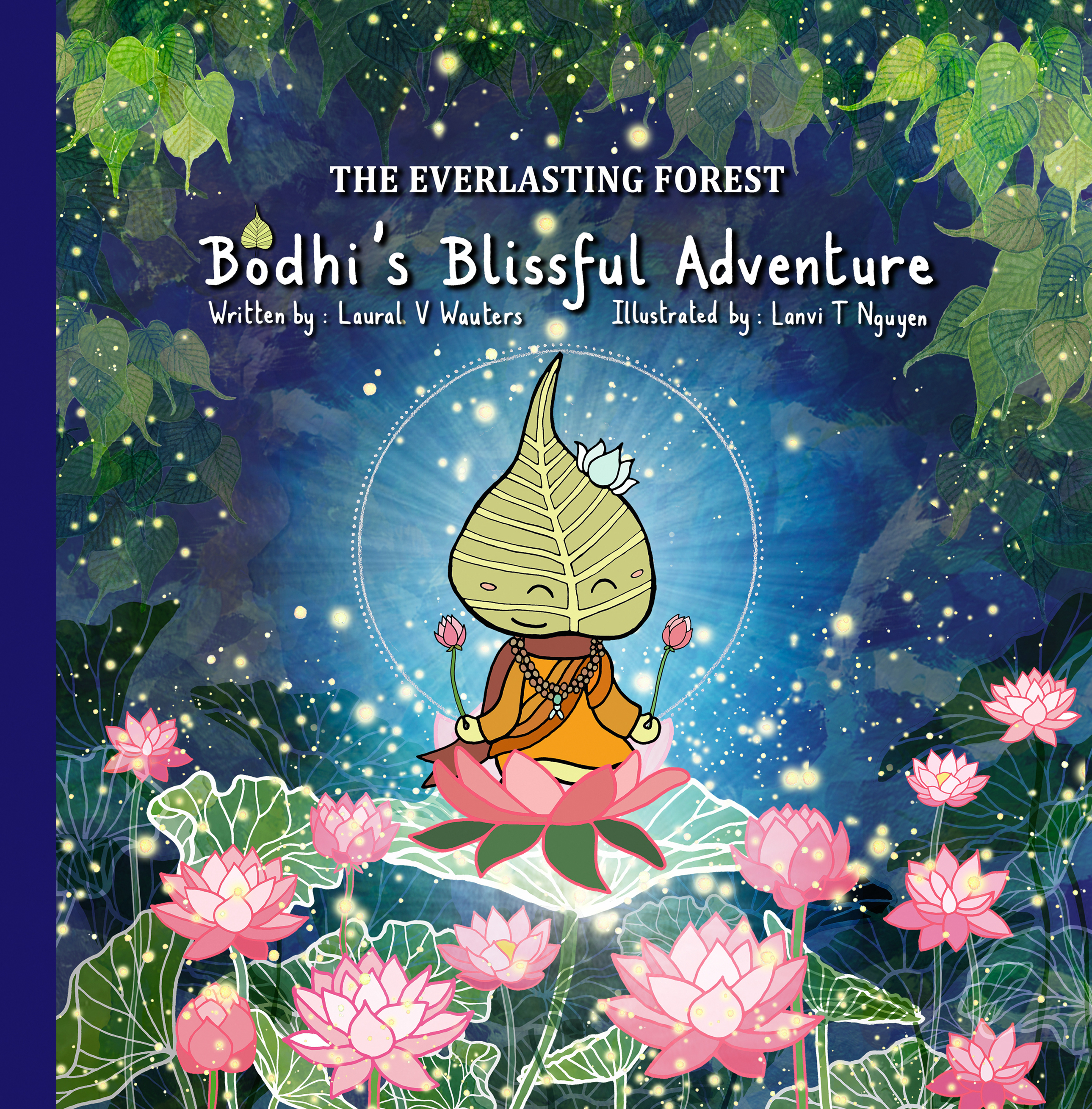
Listen in as Blissful Bodhi receives a special birthday present from Wise Old Owl. Join Bodhi and best friend Truthful Tea Leaf to learn how the lotus flower, the Bodhi tree, and the Buddha are related.

Discover how Blissful Bodhi was named and why lotus flowers appear wherever Bodhi goes.

Children of all ages will enjoy this enchanting nature-based story of Buddha and the Bodhi Tree.

A deeper look inside the story: Blissful Bodhi has taken a sacred vow of silence, but is ever watchful, mindful and helpful. Truthful Tea Leaf is Bodhi’s best friend, who lives in the foothills of the nearby Himalayan Mountains. Tea Leaf speaks for Bodhi whenever it is needed. Bodhi is often in a reflective stance holding lotus flowers in both hands or offering them to others. Lotus flowers are symbols of serenity, truth and grace. A lotus flower rests gently on Bodhi’s head. Blissful Bodhi wears a draped robe that symbolizes simplicity and the detachment of materialism. It honors how trees drop their leaves as they turn from green to yellow, orange and brown. The colors of Bodhi’s robe are created by dyeing hemp cloth in an infusion of turmeric and curry powder. Blissful Bodhi carries a small compass to help Tea Leaf with directions as they travel around the world. A mala necklace, draped over Bodhi’s shoulder, is made from 108 Bodhi seeds (Indian Soap-berry, Sapindus mukorossi).

Blissful Bodhi’s Family: Blissful Bodhi is a member of the large fig family that includes the Great Banyan Tree in India along with a wide variety of wild and domestic trees that produce edible and non-edible figs. Bodhi is named for the exact fig tree (Ficus religiosa) that Gautama Buddha sat under when he attained enlightenment over 2500 years ago. A branch from the original Bodhi tree was planted in Sri Lanka a couple hundred years later, in 288 BCE. A sapling of that tree, known as the sacred Jaya Siri Maha Bodhi or Bo tree, was then transplanted to the town of Bodh Gaya in Bihar, the northeastern state in India where the Buddha sat.
Growing Climate: Tropical – hot and humid
Botanical Lineage:
- Species: Ficus religiosa (Sacred fig)
- Genus: Ficus (Fig)
- Family: Moraceae (Fig mulberry)
Ficus religiosa is native throughout the Indian subcontinent and parts of Indochina. It thrives in hot, humid weather. The Bodhi tree goes by many names including peepal, ashvattha, pho, bo, the sacred fig and the tree of enlightenment. In Thailand pho or bo trees are considered to be sacred trees. Saffron colored cloth is wrapped around their trunks. There are approximately 850 species of fig trees; each has its own unique wasp that pollinates it.
The word Bodhi literally means “tree of awakening.” It’s the shortened version of Bodhi-taru, from the Sanskrit words buddha – “awakened” and taru – “tree.” The Bodhi tree provided Siddhartha Gautama a cool and shady place to rest after a long and difficult journey. As he meditated beneath the canopy of heart-shaped leaves he reflected on his choice to endure a six-year search to understand the meaning of life and death. As he relaxed he realized that to escape a life of suffering one must release their attachment to suffering. He saw that neither a life of extreme luxury nor a life of strict self-denial allowed one to truly appreciate life itself and the laws of nature. He saw this as the “middle path.” His awakening transformed him into the “Buddha” as the “awakened one.” It is said that he then stood in front of the tree in gratitude. His wish was to share this insight with everyone. He dedicated the rest of his 40 plus years of life to teaching the four noble truths and the eightfold path.
The Four Noble Truths
- Suffering exists.
- Suffering arises from attachment to desires.
- Suffering ceases when attachment to desire ceases.
- Freedom from suffering is possible by practicing the Eightfold Path.
The Eightfold Path
- Right View/Perspective
- Right Intention
- Right Speech
- Right Action
- Right Livelihood
- Right Effort
- Right Mindfulness
- Right Contemplation/Concentration
This 34-page, 8.5″ x 8.5″, softcover book compliments The Everlasting Forest – A Worldly Adventure.
Copyright © 2021 by Lanvi T. Nguyen and Laural V. Wauters.
All rights reserved
 The Everlasting Forest